Nikkei Veritas interviews Georg Kell: “Corporate AI use and governance are essential for a sustainable society.”
Interview: Nikkei Veritas, 10 April 2026 · Interviewer: Daigi Endo, QUICK ESG Research Institute.
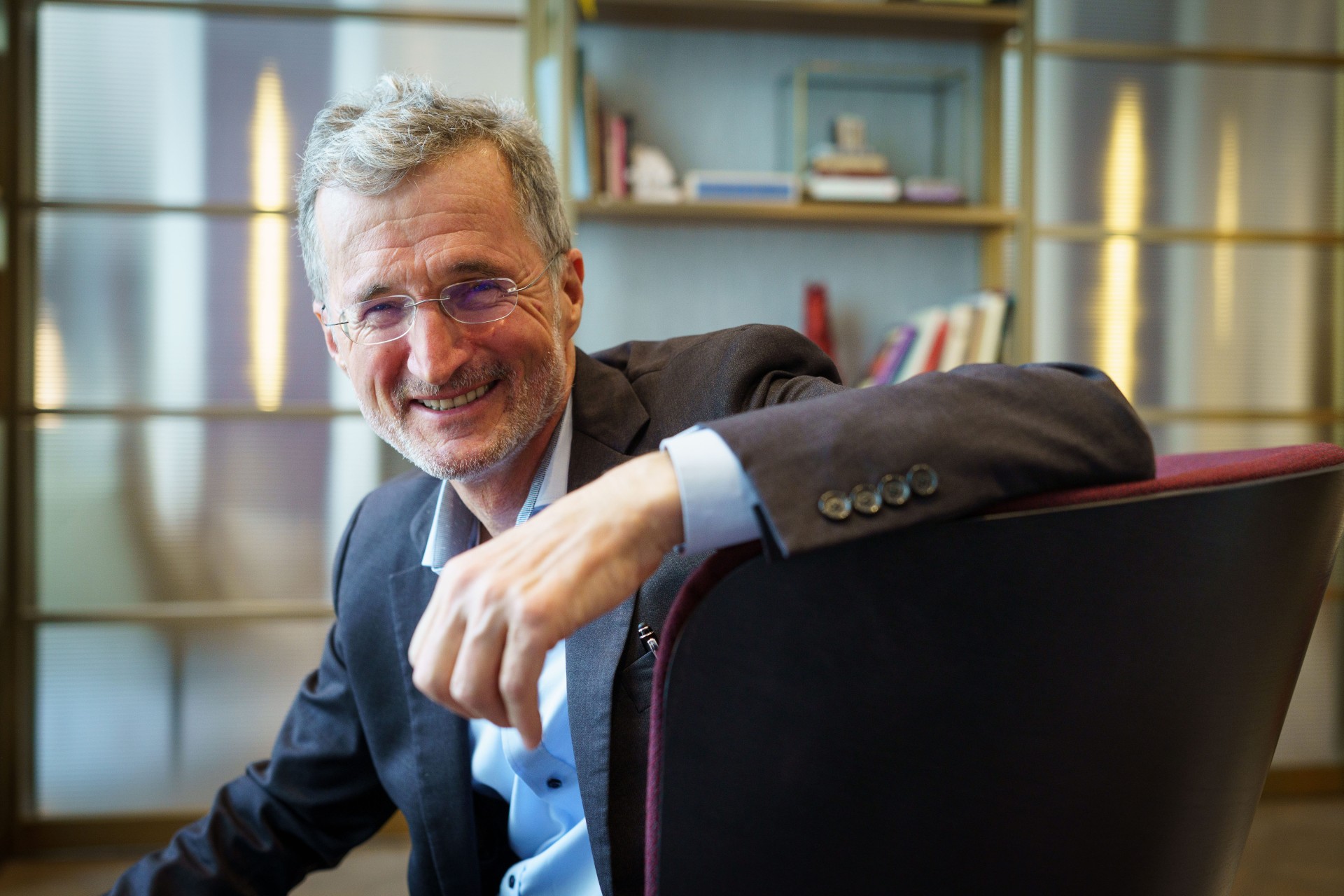
Nikkei Veritas has published a long-form interview with Georg Kell — founding Executive Director of the UN Global Compact, now Chairman of Arabesque Group — on where sustainability is heading, what it means for companies, and how AI and corporate governance need to evolve together.
The piece is part of Nikkei’s Sustainable Investment Frontline (サステナブル投資最前線) series and was conducted in Tokyo in March 2026 by Daigi Endo of the QUICK ESG Research Institute. What follows is an English summary for an investor audience; the original Japanese article is linked below.
The sustainability trend is about to come back — strongly
Kell’s starting point is an observation about the moment: global rule-harmonisation has stalled, consensus has fragmented to national and regional level, and the business world is asking a genuine question about how to engage with sustainability from here. His prediction is nonetheless unambiguous. The sustainability trend, he tells Nikkei, is about to return — strongly — driven by four forces.
- Geophysical reality.Water shortages and extreme weather demand adaptation. Societies are being compelled to act rather than choosing to.
- Sustainability in prices.Climate risk is showing up directly in property insurance premiums, in agricultural commodity prices, and increasingly in bank lending. Kell calls this “a revolution” — sustainability factors are now driving engagement via the market’s own price signals, not just policy.
- Irreversible technology.Green technology, renewables, and their falling cost curves have set a direction of travel that does not reverse. Used well, technology creates new business models that connect directly to sustainable outcomes.
- The next generation.Long-term preference data suggests markets worldwide are becoming more sensitive to environmental impact. The generation coming up is more conscious, and more motivated to act on it.
Sustainability as “insurance” — and as an earnings driver
Kell frames corporate response to environmental change around two linked points for Nikkei’s readers.
Not investing is the expensive choice. Firms that skip sustainability investment expose themselves to tail risks they will eventually pay for — accidents, corruption scandals, governance failures — the kind of events that wipe out billions in brand value. Sustainability spending, in that light, behaves like insurance against future loss.
Sustainability and financial performance are increasingly joined. Resource efficiency, circular business models, and stronger governance drive genuine productivity gains. Employee motivation, human capital, and operating efficiency all respond to governance maturity.
The second observation Kell offers to a Japanese audience is specifically relevant there: in a fragmented world, companies should stop searching globally for imported “best practice” and look inward. Japanese firms have real strengths in their DNA and in the structure of their organisations — the task is to surface those strengths bottom-up and build sustainability around them, reinforced by collaboration with like-minded peers.
“In an uncertain world, there is a premium on integrity and values. When companies have excellent brands and communicate those values, they are better recognised in the market.”
Georg Kell, Nikkei Veritas interview
AI for sustainability — and the governance question it creates
Asked about technology specifically, Kell singles out AI as the domain where sustainability and investment are now intersecting at speed. He is explicit about where Arabesque sits in that story:
“A new movement is emerging in investment — the use of AI to leverage sustainability information. I am very proud to be part of Arabesque Group, a pioneer in this space. Using Arabesque’s autonomous AI platform, AutoCIO, you can build portfolios that take water resources and climate into account, and understand how sustainability factors affect performance. AI is also smoothing disclosure and reporting.”
Georg Kell, Nikkei Veritas interview
But Kell is equally direct about the flip side. Low-quality data leads to bad predictions. The process behind AI-driven decisions needs to be transparent, explainable, and traceable. Humans have to stay involved at every material step.
His argument for boards is the sharpest line in the piece: oversight of AI should ultimately sit at the board level, and be as rigorous as oversight of financial reporting. Companies need AI policies, named AI-accountable managers, and formal verification processes for the data AI systems consume and produce.
It is in this context that he returns to Arabesque’s product design. AutoCIO, he tells Nikkei, is deliberately described as a “co-pilot” — a system whose autonomy can be dialled up or down, and whose every step can be controlled by its human operator.
Nikkei Veritas interviews Georg Kell: “Corporate AI use and governance are essential for a sustainable society.”
Nikkei Veritas interviews Georg Kell: “Corporate AI use and governance are essential for a sustainable society.”
Read more →

AutoCIO is now available in Gemini Enterprise.
Our Financial Forecasting Agent is now live in the Gemini Enterprise Agent Gallery — design, optimise, and enhance portfolios inside Google’s agentic platform.
Read more →
Forbes Japan features Georg Kell on luxury, transparency and the role of AI.
Arabesque’s Chairman delivers a keynote in Tokyo on how scrutiny over sourcing is reshaping luxury — and what it means for investors.
Read more →